Author: Dominik Schneider
Share this post:
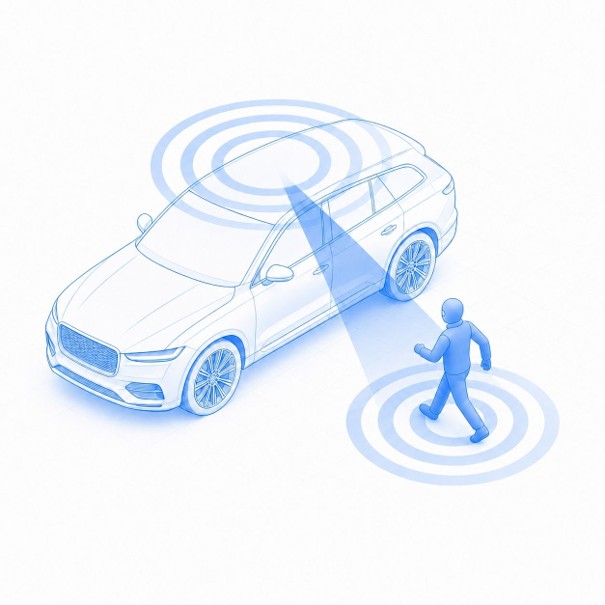
How can parked vehicles be monitored reliably without unnecessarily draining the battery? This question was at the heart of a development project by embedded brains. The goal was to create the third generation of a radar sensor platform for a camera-based vehicle monitoring system. The solution: a highly compact, pulsed 24 GHz radar that accurately detects moving objects while operating with minimal power consumption.
Intelligent vehicle monitoring is becoming increasingly important, particularly in urban en-vironments. Theft, vandalism, and damage around parked vehicles are growing challenges. For vehicle owners, such systems can provide significant added value by helping detect crit-ical situations early, better understand incidents, and—depending on the system design—alert users via an app or other notification channels when relevant events occur.
For battery-powered systems, it is essential that sensors are not only reliable but also highly energy-efficient. Keeping a camera active at all times is often not ideal: it consumes consid-erable power, generates large amounts of data, and requires continuous image processing. There is also another consideration: constant recording of a vehicle’s surroundings can raise privacy concerns, particularly when public or semi-public areas, license plates, or individu-als are captured.
A radar sensor positioned upstream of the camera can therefore play a key role in creating an energy-efficient and privacy-conscious vehicle monitoring system. The radar detects whether anything relevant is moving around the vehicle. Only when a specific event occurs are additional functions activated, such as a camera, data analysis, or user notifications.
The Challenge: Reliable Vehicle Monitoring with Minimal Power Consumption
The requirements for the new radar platform were demanding. The system had to reliably detect moving objects, including their distance, speed, and direction of movement. At the same time, it needed to deliver accurate results under challenging weather conditions and in complex environments.
Additional requirements included a compact design, cost-efficient implementation, and a communication interface allowing operating parameters to be configured and firmware up-dates to be installed.
For vehicle monitoring applications, this combination is especially important: the system must operate reliably in the background without unnecessarily draining the vehicle battery while still detecting relevant movement without continuously generating large volumes of image data.
What the Radar Platform Delivers
- Reliable motion detection: Detects moving objects at configurable distances of up to 20 meters.
- Energy savings: Pulsed operation reduces power consumption by more than 90%.
- Reduced system load: The camera does not need to remain active continuously and can be activated only when required.
- Supports privacy-conscious concepts: Image data is generated only when relevant events occur.
- High precision: Distance, speed, and direction of movement can be determined in re-al time.
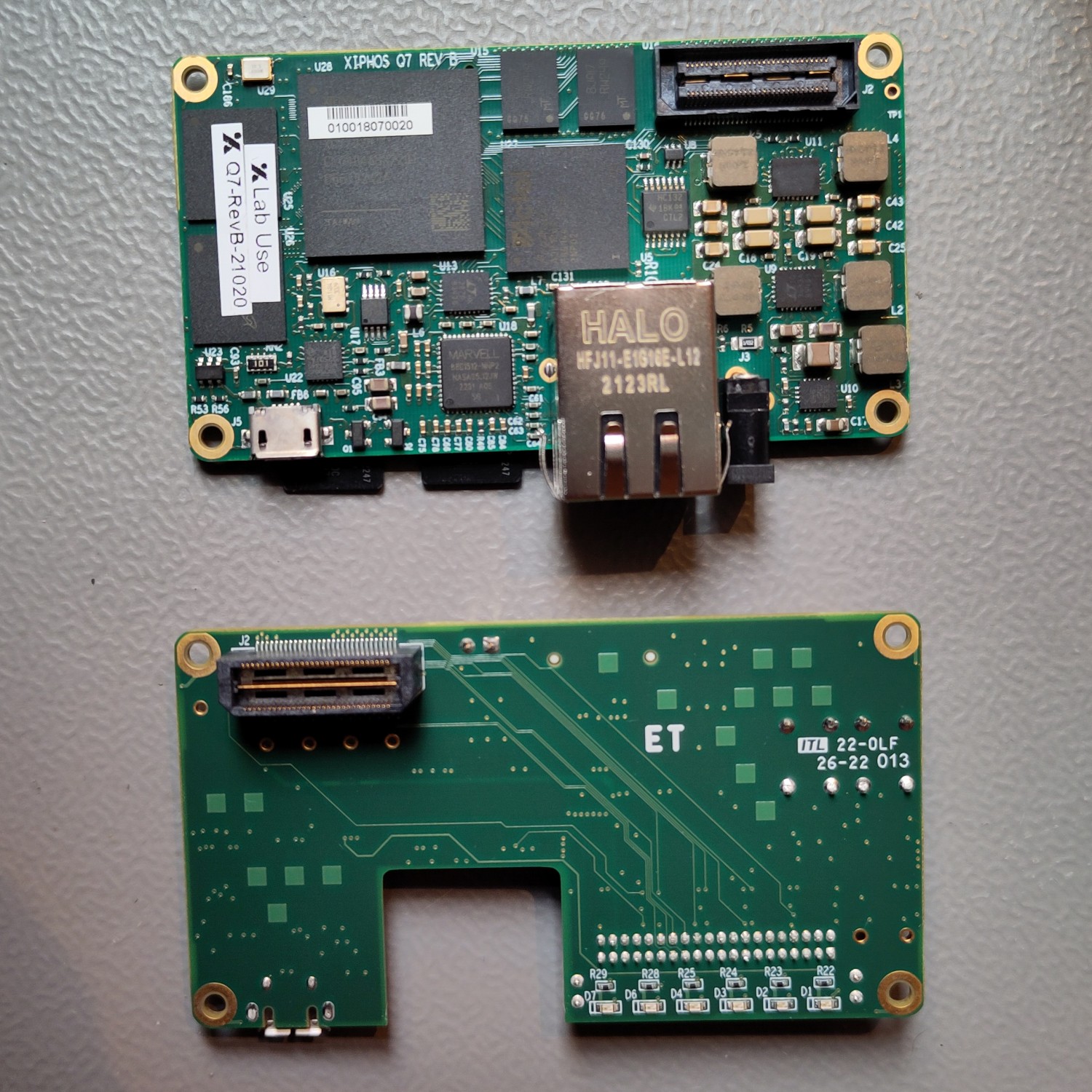
- Compact design: The entire platform is integrated onto a single PCB using SMD components.
- Flexible configuration: Operating parameters and firmware can be updated via an I²C interface.
- Broad applicability: Suitable not only for vehicles, but also for smart home, Industry 4.0, and security applications.
The Solution: Pulsed Instead of Continuous Operation
The embedded brains development team implemented a carefully optimized system archi-tecture consisting of energy-efficient analog and digital components, a 24 GHz industrial ra-dar sensor, a low-power 32-bit microcontroller, and optimized algorithms for real-time sig-nal processing.
A key innovation was the use of pulsed operation. Instead of transmitting continuously, the radar emits short, precisely timed pulses. This reduced the platform’s power consumption by more than 90%—a critical advantage for battery-powered vehicle monitoring applications.
At the same time, a frequency-hopping method enables efficient processing of received sig-nals. Distance, speed, and direction of moving objects can be determined in real time with reduced computational effort. An optimized signal-processing algorithm additionally filters interference and reliably extracts relevant movement data.
Why Radar and Cameras Work Well Together
In camera-based vehicle monitoring systems, radar can play an important upstream role. While cameras provide visual information, radar detects movement independently of light-ing conditions and remains reliable even in challenging environments. This is particularly valuable when monitoring vehicles at night, in parking garages, during rain, or in complex urban settings.
The key advantage lies in the combination of both technologies. The radar system can effi-ciently determine whether anything is moving around the vehicle. As a result, the camera does not need to run continuously and can be activated only when a relevant event is detect-ed. This reduces energy consumption, minimizes unnecessary data processing, and signifi-cantly extends the operating time of battery-powered systems.
Such an architecture also supports privacy-friendly vehicle monitoring. Instead of continu-ously recording footage, the system can operate on an event-driven basis. This is especially important when public or semi-public areas may be within the camera’s field of view.
For users, this means vehicle monitoring becomes not only more precise but also more prac-tical. Relevant events can be detected, documented, and—depending on the overall system—forwarded to the user, for example through app notifications. The result is a system that combines radar, cameras, and intelligent analytics to provide greater security and transpar-ency around parked vehicles.
Compact, Configurable, and Ready for Production
The developed radar platform can detect moving objects at configurable distances of up to 20 meters. Distance and speed resolution can be adapted to the specific application.
The entire system is integrated onto a single PCB using SMD components, reducing both space requirements and costs while simplifying integration into the customer’s installation environment. This compact design is particularly important in vehicle applications where installation space is limited.
A standardized I²C maintenance and communication interface enables configuration of op-erating parameters and firmware updates, allowing the system to be adapted to changing re-quirements even after deployment.
From Prototype to Production
Following extensive laboratory and field testing, the integrated radar system is currently be-ing prepared for series production by the customer as part of a camera-based vehicle moni-toring solution. Through this project, embedded brains has contributed to the development of a platform that combines precision, energy efficiency, and compact design in a practical real-world application.
The project demonstrates how intelligent hardware design, advanced signal processing, and application-specific system engineering can significantly enhance vehicle monitoring sys-tems.
Potential Beyond Vehicle Monitoring
The radar sensor platform is not limited to camera-based vehicle monitoring. It also offers interesting possibilities in smart home applications, Industry 4.0 environments, and security technology.
Potential use cases include energy-efficient motion detectors, monitoring of conveyor sys-tems and mobile robots, and protection of sensitive areas. Wherever reliable motion detec-tion and low power consumption are critical, the platform provides a strong technological foundation.
Outlook: Further Miniaturization and AI-Based Analytics
embedded brains is currently working on further miniaturizing the platform and integrating AI algorithms. The goal is to improve object detection and motion analysis capabilities while opening up new application areas for compact, energy-efficient radar technology.
With the development of its pulsed 24 GHz radar platform, embedded brains demonstrates how intelligent system architecture, efficient signal processing, and application-specific hardware development can create powerful embedded solutions for demanding sensing ap-plications. For vehicle monitoring, this means greater precision, lower energy consumption, and a technological foundation for event-driven, privacy-conscious systems.
Are you planning your own radar sensor project?

Whether for vehicle monitoring, smart homes, industrial applications, or security systems:
embedded brains supports companies in developing compact, energy-efficient radar solutions tailored to their specific applications.
Schedule a free initial consultation with Peter Rasmussen, Managing Director of embedded brains and an expert in radar sensor technology.
Together, we will determine which technical solution best suits your application – from the initial idea through to a production-ready implementation.
Simply email peter.rasmussen[at]embedded-brains.de to arrange your free initial consultation.
FAQ: Frequently Asked Questions About Radar-Based Vehicle Monitoring
Matthias Goebel
/
4. April 2017